


Inside Richard’s One Man Exhibition at House of Bruar Gallery

Some exhibitions are quiet affairs, where visitors move from painting to painting in gentle silence. Richard’s recent one-man exhibition at the House of Bruar Gallery in Perthshire had that contemplative quality, but it also offered something more immediate: the rare chance to watch the artist at work.
Fresh from the opening weekend, Richard returned with stories of warm conversations, close looking, and a steady flow of visitors keen to understand how his paintings take shape. Across the weekend, he worked on a number of pieces in the gallery itself, opening up his process in a way that made the exhibition feel alive.
For many who came along, the pleasure was not only in seeing finished paintings on the wall. It was chatting with Richard in a warm and friendly atmosphere.

A personal opening weekend in Perthshire
House of Bruar Gallery offered a fitting setting for the exhibition. Set in Perthshire, surrounded by some of Scotland’s most admired scenery, it gave Richard’s work a context that felt close to many of the subjects and moods that have shaped his paintings over the years.
The opening weekend was informal in the best sense. Visitors could move through the exhibition at their own pace, speak with Richard directly, and return to paintings after watching him work. That rhythm created a welcome balance between viewing and conversation.
At the House of Bruar Gallery, that focus gave visitors a fuller sense of Richard’s work.
The exhibition showed what it is that makes Richard tick, his understanding and knowledge of the birds and animals he paints and the process of converting that into a painting.
Watching paintings take shape
One of the most memorable parts of the weekend was Richard working on paintings while visitors watched. Demonstrations can sometimes feel staged, but this had a more natural quality. He painted as he would in the studio, while also taking time to explain decisions as they arose.
That meant visitors could see process rather than just outcome.
As always, Richard began with an image of the subject in his head, then with the aid of a study skin (a pheasant on the first day), worked the painting up from a white under-painting, showed how marks create movement and detail is built over a period of time, like coloured sheets of glass on top of one another but always keeping the light and the belief that the subject matter is already alive in front of you.
Visitors could ask about materials, brushwork, and the challenge of knowing when a work is finished. These are familiar questions, but they become more meaningful when asked in front of a painting still in progress. Oh, and they could also ask how he decides on where he will place the famous fly!

The value of speaking with the artist
For anyone who loves painting, speaking with the artist can change how a work is seen. It does not replace personal interpretation, and it should not close down the viewer’s response. Instead, it can add layers.
Over the weekend, Richard spoke with visitors about the techniques and inspirations that have informed his work across forty years. These conversations gave people a sense of the practical and personal experience behind the paintings.
Technique is often misunderstood as something separate from feeling. In truth, the two are closely linked. The way an artist handles paint affects the emotional weight of a piece. Although Richard's paintings may appear hugely detailed, he has learned over the years just where the detail needs to be and where a looser feel will enhance the composition. The use of a larger brush will make fur or downy feathers seem much softer and realistic than over-working with a 000 kolinsky sable brush!
There is also something generous about revealing process. Many artists prefer the completed painting to stand alone, and that is entirely understandable. Yet when an artist opens the door to how a work is made, it often deepens appreciation rather than reducing mystery.
The mystery remains. It simply becomes better informed.
Forty years of influence in the work
A long career gathers influence from many places. Some are obvious: landscape, weather, light, changing seasons, or the animals and birds of certain a place. Others are quieter: a remembered colour, the pattern of plumage, the way a subject moves or interacts with their surroundings.
Richard’s work carries that sense of accumulated observation.
During the exhibition weekend, he shared some of the inspirations that have stayed with him over the past forty years. Rather than treating inspiration as a sudden event, he spoke about it as something built through attention. This is an important distinction. For many painters, the work begins long before a brush touches the surface.
It begins in the habit of looking.
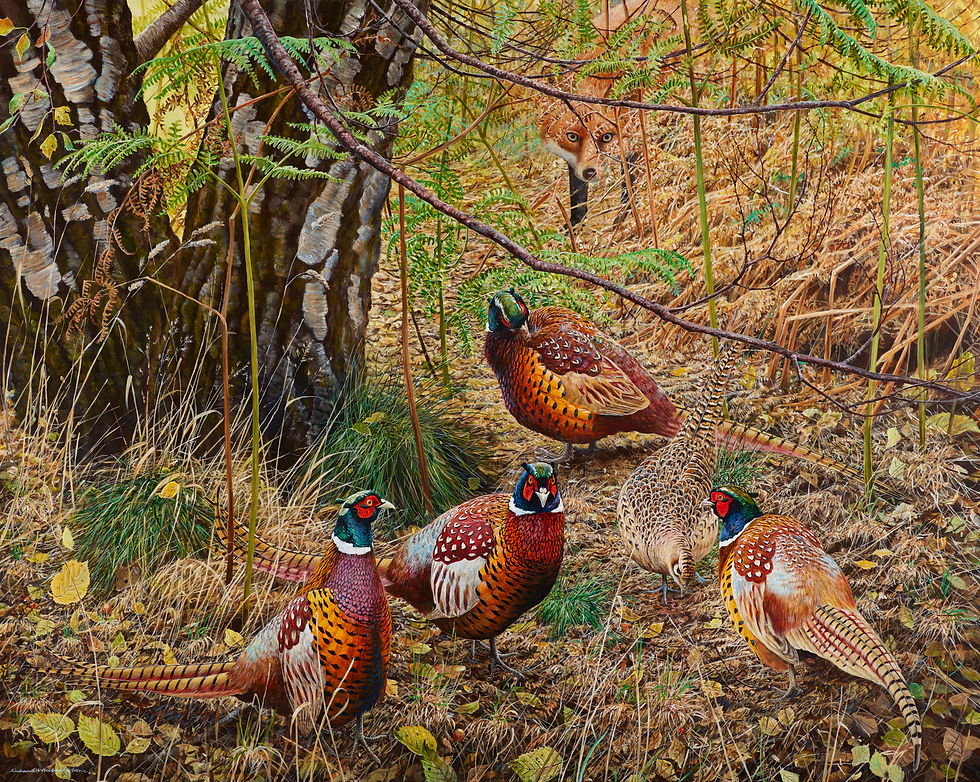
Richard of course breeds grey partridge and pheasants and observes them endlessly at close quarters. The sketch or memory of the anatomy of a partridge can be turned into a grouse with know-how and understanding of what he needs to achieve.
In a gallery setting, these wildlife subjects are translated into paint. The viewer is transported into believing the bird or animal is alive in front of them, they are invited into the artist’s remembered and reimagined experience of something truly beautiful.
That is where Richard’s years of practice and knowledge become visible. The paintings are not literal records. They are shaped by memory, skill and feeling. They carry experience differently from a photograph. They ask the eye to believe there is a life in front of them and a subject ready to move.

A weekend shaped by conversation
The opening weekend stood out because it was built around exchange. Richard brought the work, the skill, and the stories. Visitors brought curiosity, questions, and their own ways of seeing.
That kind of exchange is central to the best gallery experiences. Art may begin in the studio, but it changes once it meets an audience. People notice things the artist may no longer see. They connect works to their own memories. They ask questions that open new paths through familiar subjects.
For Richard, the weekend offered a chance to meet some of the customers who have purchased his paintings from Bruar since he began showing there, in 2008. For visitors, it offered insight into a practice shaped over many years.
The result was a warm and thoughtful opening, grounded in the pleasure of looking closely.

"Highland Tiger" just one of Richard's new paintings, shown for the first time.
Carrying the exhibition home
Richard’s return from Scotland brings with it more than memories of a successful opening. It brings the renewed energy that often follows direct contact with an audience.
Back in the studio at home in Derbyshire, there are commissions to complete, a 2027 calendar to plan and of course his Winter Exhibition, beginning in November
Studio work can be solitary. Exhibitions change that. They allow the paintings to be tested in public, not in a harsh sense, but through attention. A viewer lingering in front of a canvas is a form of response. A thoughtful question can stay with an artist. A conversation about subject-matter, place, or technique can feed back into the work still to come.
That is one of the quiet rewards of a one-man exhibition. It gives room for a body of work to be seen, but it also creates momentum for the next stage.
Over the weekend, the most striking thing was not just the finished paintings. It was the sense of a man obsessed with a love of wildlife, rooted in the daily discipline of making his subject come to life.

Comments